rabbit, rabbit, rabbit, rabbit

rabbit, rabbit, rabbit, rabbit
Yew Trees are amongst the oldest living plants and have many folklore associations some of which might be quite offensive to twenty-first century humans so, if you are squeamish, brace yourself for the last paragraph.
The word Yew comes from the Anglo Saxon word Giuli, the same stem word as for Yule. The Yule Log was originally an oversized hard lump of yew wood that was left burning on the fire for 12 days; I do not know at what point in time it transformed into an oversweet chocolate cake that I baked on Christmas Eve when my children were still young and lasted in my larder for 12 minutes. The Gaelic word for yew tree, however, is Ioho or Ioha and the Scottish island of Iona probably derives its name from the groves of sacred yew trees planted there; Iona was once a powerful Druid Centre. There is a famous tree in Perthshire, Scotland, called the Fortingall Yew which is thought to be between two and five thousand years old. Beltane Fires used to be lit every year in a cleft of its trunk and a popular legend claims that Pontius Pilot played in its branches as a child. In Irish mythology the Yew is one of five sacred, and/or magical, trees brought from the Otherworld. In the Celtic Calendar the Yew Tree sat where the Old Year became The New.
The Yew is often described as the tree of birth, death and rebirth. When the tip of a branch touches the ground it frequently puts down roots and another trunk is formed. New vertical growths either inside a decayed hollow trunk or outside of the original trunk may also occur and this ability to renew its vigour is why the Yew is regarded by many as Immortal. Rings of Yew will often grow if the original tree is left to its own devices.
The tree is associated with death in several ways; one example is that English bows were made of Yew and used to kill thousands of men in war.
Many churchyard Yews were growing in that place long before the church was built and not planted to make sure the farmers kept their cattle well fenced in for fear of poisoning, as is commonly suggested. It is thought that Pagans associated Yews with preventing the dead from walking and Christians adopted this belief to bring Pagans into the Church. The shallow net of roots is regarded as impenetrable by the spirits and, more gruesomely, that the roots grow into the eyes of the dead so they cannot see their way back. However, others believe that the berries and bark are red because the roots grow into tongues, thereby giving a voice to the dead. Either view gives the story writer plenty of ideas for a macabre tale.
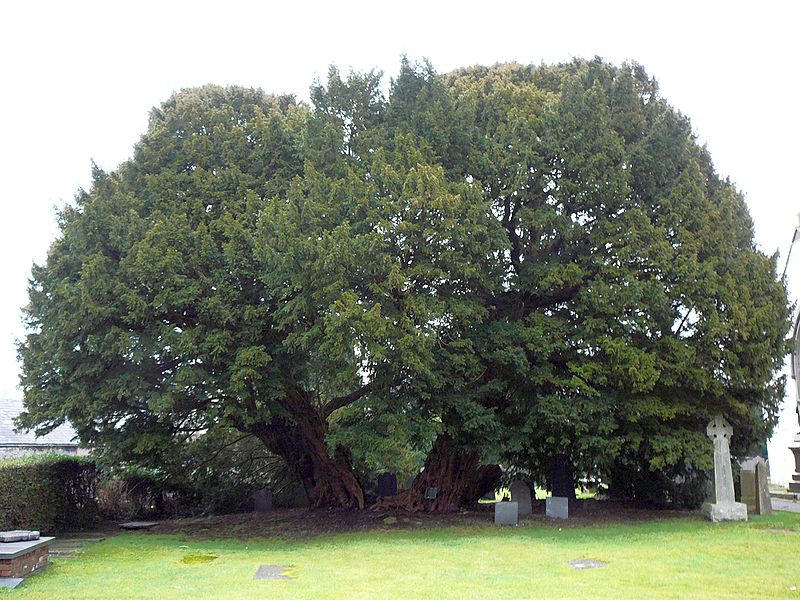
The Llangerny Yew – photo Emgaol (2010) used under Creative Commons License
Simple post today, suffering from extreme exhaustion.
I was going to write botanical notes about xylem so you’ve all had a lucky escape!
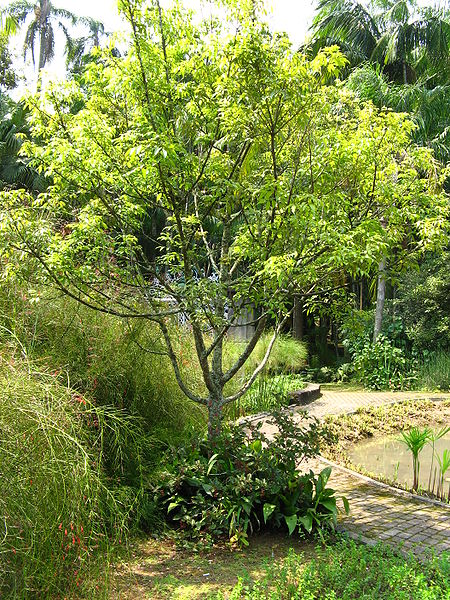
Xylopia brasiliensis – photo originally uploaded to Flickr by Colchicum; used under Creative Commons Licence
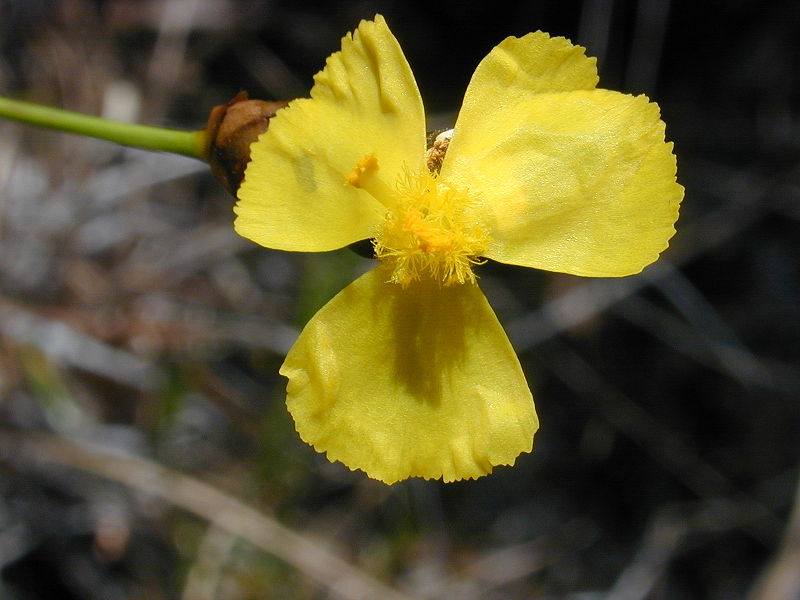
Xyris complanata – photo by Eric Guinther (June 2005); used under Creative Commons Licence
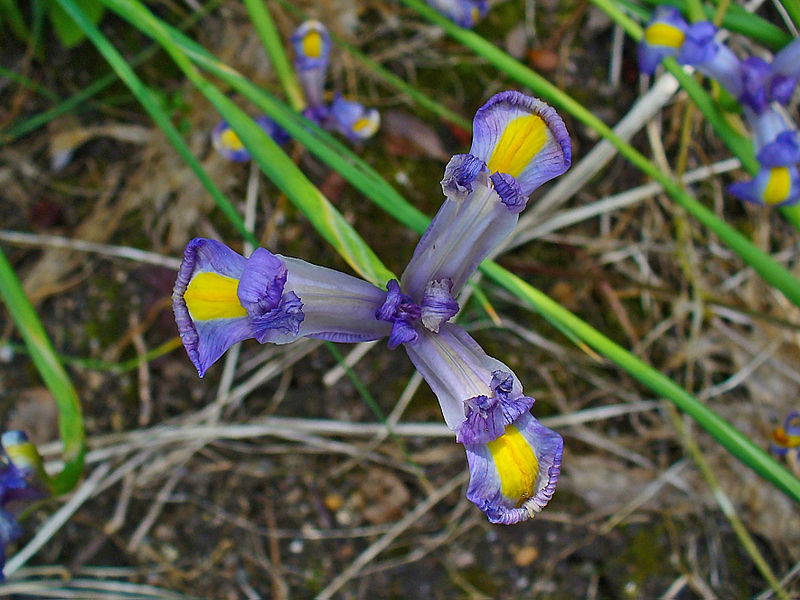
Iris Xyphium –
Photo by H Zell (June 2009) used under Creative Commons Licence
A few years ago I bought a tepee. It is, of course, not made of animal hides but of a sturdy canvas although, from a couple of hundred yards away, it looks just like the real thing.
I am small and have to enlist the help of taller friends to put up the poles and wrap round the canvas; the more extrovert among us then have a dance but the more self-conscious just look embarrassed. There is something very different about sitting in a tepee, it is not like being in a normal tent; I find that it both relaxes and inspires me at the same time. I have a wild area in my garden with a large pond and from spring until late autumn the tepee stands close by it. There is a smoke vent at the top and sometimes I lie face up and watch the clouds float past overhead. Occasionally I use my macbook or iPad out there but this is a place better suited to pen and paper or needle and thread than to electronic gadgets. I am sure that to some eyes my tepee looks completely incongruous in my English Garden with a Victorian Greenhouse , herbaceous borders and formal hedges all within sight but it is another perfect place for solitude and I love it.
If you have never set foot inside a Botanic Garden I hope this short piece will encourage you to visit one; not only are they fascinating places but one day they may play an important part in our survival.
I was lucky enough to grow up in Oxford where my father worked for the University; visiting the Botanic Garden (Oxfordbg.blogspot.co.uk) was a regular part of my childhood and, combined with my mother’s love of gardening, led to my becoming a passionate gardener with a large greenhouse that competes for my time with preparing my book for publishing.
The Garden lies next to the River Cherwell and is a peaceful oasis in the centre of the city; it was founded by Sir Henry Danvers in 1621 for “the glorification of God and for the furtherance of learning”. The walls and arches are on a very grand scale and building them used up most of the money Danvers had donated to set up the Garden so it took some time for the plant collection to increase; however, the conditions created within the walls enable a wide range of plants from all parts of the world to grow there.
The oldest tree in the Garden is an English Yew; in 1645 when it was planted by the Botanic Garden’s first official curator, Jacob Bobart, it would not have been considered a medicinal plant but many people now donate the clippings from their yew trees to be used in the production of cancer-fighting drugs.
When I was on the Italian Gardens Tour I mentioned in yesterday’s blog I felt privileged to visit the Pisa Botanical Garden which is the oldest university Botanic Garden in Europe having been founded in 1543 by the physician and botanist Luca Ghini who was given the post of Chair of Botany by Grand Duke Cosimo I de” Medici. I hope that it has retained the same feeling of history nearly twenty years on.
In 1997, when visiting St. Louis, I was given the most wonderful guided tour of the Missouri Botanical Garden; my guide was a lady volunteer with a real love of, and enthusiasm for sharing, this wonderful place. Founded in 1859, this is the youngest of the three Gardens mentioned in this article but is the USA’s oldest Botanical garden in continuous operation and within its 79 acres holds one of the world’s largest collections of rare and endangered orchids.
Visit these places if you get the chance, they are living history.
what's shiny today?
sueturner31
From suburban lawn to backyard homestead...with ducks. A journal by Lori Fontanes
Parks & Gardens in London, the UK & abroad
Gardening on the edge of a cliff
Writer
A Writers Journey
"If you have a garden and a library, you have everything you need." Cicero
An Englishman and an Italian / English Dictionary
Finding hope in a chaotic world...
Images and stories from my travels and life in the Northern Territory and Queensland.
Where was I? Oh yes...
 lynnerevettebutler